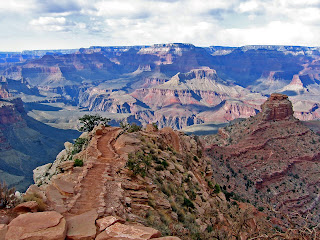
One of my favorite views: Above Cedar Ridge, South Kaibab Trail
"A journey is a person itself; no two are alike. And all plans, safeguards, policing, and coercion are fruitless. We find after years of struggle that we do not take a trip; a trip takes us." -- John Steinbeck, in Travels With Charley
That quote from Steinbeck is one of my favorites. Thus, the first thing I like to open a hiking tour orientation with is saying: Be flexible. We may come to trips with prior expectations, thinking we know what a trip is going to be, setting ourselves up to be disappointed with something that just isn't how we imagined it. Be present/flexible and you'll be more likely to be rewarded with an enjoyable experience you may have missed otherwise.
So what do huge vistas, California condors, geologic wonders of the world, mule pack trains, tired legs, and the best bacon you have ever eaten have in common? They are all possible things you may see or experience when hiking down into and back out of the bottom of the Grand Canyon & Phantom Ranch.
It is recommended to do this hike over two days. Hike down the first day, spend the night at either Phantom Ranch or Bright Angel Campground (reservations required well in advance for both), then hike out the next day.
Being flexible is definitely recommended for enjoying your hike into/out of the Grand Canyon. The trip definitely "takes you". No two trips are alike. Your first trip? Prepare yourself** and you'll be primed to enjoy your journey more.
Train your body. This is not a beginner's hike. Try hiking in Zion first if you haven't spent time in the vertical world of canyons. Even if you don't have hills where you live, spend time climbing stairs or the stairmaster at the gym. You're spending most of your hike descending (or ascending) nearly 5000 vertical feet (or more, from the North Rim). Your quads, hamstrings, and feet will thank you later (or you'll be a case of "Kaibab Crawl").
Know your limits. Recognize that if you hike down into the canyon, you will need to hike back out. No, you can't book a mule ride out at the last minute. Terrified of heights? Try Zion first. Wait until you have experience and confidence to undertake this amazing hike.
Use hiking poles. IMHO, hiking poles were made for the Grand Canyon. You'll be hiking on steep, rocky, eroded paths. I find hiking poles help to save quite a bit of fatigue in my knees and quads on the descent. They also enable me to use my arms to help push up "tall people steps" on the ascent.
Take "Full Meal Deal" breaks. This means take a break every hour to 90 minutes. Take off your pack, put your feet up, eat a snack, drink some water (or electrolyte replacement drink). This doesn't mean you have to take a half hour break. Five to ten minutes will do. Keep yourself hydrated and eat to sustain energy levels.
Start early. If you're staying at Phantom Ranch, this shouldn't be a problem. They wake you up at 4:30 a.m. for a 5 a.m. breakfast! (Mmmm, I can smell the bacon now...!) We usually head out around 6 - 6:15 a.m. to beat the heat and give us plenty of time to enjoy the trail.
Be prepared for the weather. With a 5000' descent/ascent, you'll find at any given time a temperature difference of ~ 3 degrees per 1000'. Add the time it takes to hike down/up, and depending on the time of year, you could experience a 50 degree temperature difference (or more). Spring & fall on the trail are usually the most user-friendly times to go. Check out the GCNP weather page here.
Address "hot spots" immediately. If you are feeling a hot spot or blister developing, don't wait. Pull over and tape or moleskin that hot spot. Distracting pain can make the hike a lot less fun. Trim toenails ahead of time, too. (Check out the posts on blisters here & here if you want more info.)
It is what it is. This means that the Grand Canyon, and especially the inner canyon, is an isolated place. Phantom Ranch is quite civilized for where it is located. It has running water and showers (except when they work on the water lines). It has cabins with bunk beds, linens, and towels. (Bring earplugs!) They have set meal times and menus that have to be booked in advance. Make sure you appropriately plan your lodging or meals or hike with a group that plans for you. Everything is delivered by mule train, even the mail! If you have special dietary needs, bring what you need with you.
Don't get Psyched Out. Put one foot in front of the other on the way up. You'll get there! A tip: You'll be able to track your progress if you look back at where you've come from, not how far you have left to go.
So train, pace yourself, eat, hydrate, start early... do all those things and you'll be stylin'! Remember, there's ice cream at the Bright Angel Lodge less than five minutes from the Bright Angel Trailhead on the South Rim...! You deserve it! ;)
More information:
- GCNP website here.
- A musical journey (my favorite parts of Grofe's Classical Grand Canyon Suite) here.
- Grand Canyon Natural History Association here.
- If you want to go hiking with Timberline Adventures, their website is here.

Near the bottom of South Kaibab Trail
** Note: No one can predict exactly what the Grand Canyon will present to you. This is a partial list and not a replacement for using common sense or good judgement.

